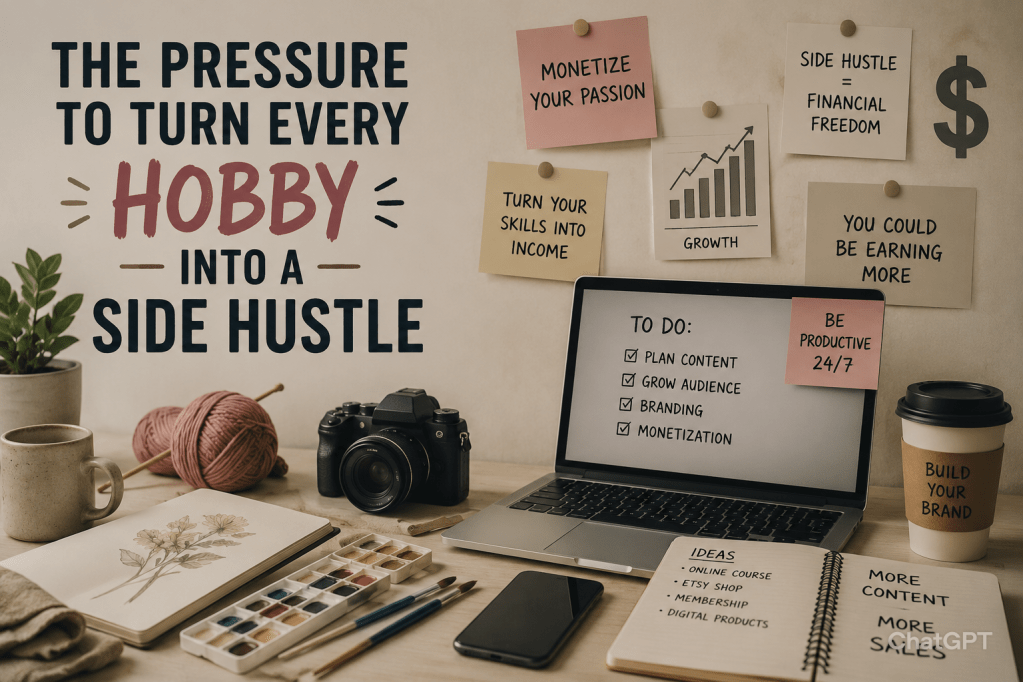
There was a time when hobbies existed simply to make us happy. Painting was just painting, dancing was just joy, and writing was a quiet escape after a long day. But somewhere along the way, the world began asking a different question: “How can you monetise it?” In today’s hustle-driven culture, every passion seems expected to become a brand, a business, or at least a side income. Social media glorifies productivity so intensely that enjoying something purely for ourselves can almost feel irresponsible. But does every hobby really need to earn money to have value? Or are we slowly losing the simple comfort of doing things just because we love them?
We are all drawn to hustle culture, whether we realise it or not, since it is the main cause of the publication or glorification of all pastimes. Additionally, having several sources of income has become crucial in our inflation-ridden world. In the past, activities classified as “hobbies” were thought of as things you could do in your spare time. It now focuses more on how profitable and popular your pastime might be. Is this the best course of action? Or are we moving in the direction of something that never ends?
The pressure of likes and comments transforms the emotional experience of a hobby. For instance, when a skilled dancer creates a social media content page, he or she considers follower counts, audience engagement, trending music, and other endless factors rather than dancing. In a sense, mistaking your talent for social media likes is a mental strain that can cause anxiety and self-doubt. This causes someone who may be incredibly gifted to lose interest in making things, painting, dancing, or any other artistic pursuit. Of course, if the thin line between hobby and algorithms is clearly drawn, social media may also be a source of joy.
Talented and skilful people are sometimes haunted by the question, “If you’re good at something, why not make money from it?” The questions provoke thought and make one feel guilty about not knowing more about social media or monetisation. In all honesty, the best approach is for someone to be content with their activity and enjoy it for mental peace. Our everyday lives are always heavily influenced by society; we are members of it and must abide by certain rules. However, what one does with their interest or expertise is a very personal matter, and it is completely inappropriate to consider society before your own well-being.
When a hobby remains personal, it becomes a refuge from the demands of everyday life—a place where creativity can flourish without deadlines, comparisons, or the need for validation. Sometimes, the greatest benefit of a hobby lies not in what it produces, but in how it makes us feel while doing it. However, productivity also depends on one’s quality of life and is not necessarily objectively visible. If engaging in hobbies helps you feel calm, content, joyous, and relaxed, it is also productive; the sole difference is that it can be measured qualitatively. It is similar to getting a good night’s sleep; you don’t always get it, but when you do, it makes the next day the most productive. In the same way, never give up on your hobbies if they make you happy. Additionally, you need to showcase your skills to the public if you can successfully find a balance between the desire to pursue a passion and social media approval.
It is easy to ignore a basic fact in a culture that frequently evaluates value by accomplishments, productivity, and continuous advancement: joy is also productive. Engaging in activities that bring us joy, energy, and calm enhances our well-being in ways that aren’t necessarily evident on a bank statement or resume. Joy boosts emotional resilience, fosters creativity, lowers stress, and aids in self-reconnection. Time spent doing something just because it makes you happy is never wasted; it’s an investment in a better, more balanced life. Sometimes granting ourselves the freedom to appreciate the things that make life richer and more rewarding is the most significant type of productivity, rather than producing more, making more money, or achieving more. It is healthy to sometimes keep one thing in your life untouched by performance!


Leave a Reply